News
What’s going on in the woods?
Want to keep up with what’s happening in the world of coppicing? Then you’ve come to the right place!
If you have something to share then drop us a line at newsdesk@ncfed.org.uk
Latest News
Imported Charcoal Remains Unregulated in Britain
Charcoal is one of Europe’s top five drivers of global deforestation. This is according to analysis by the Earthworm Foundation, a not-for-profit organisation focussed on supply chain issues. Despite this shocking discovery, charcoal is still not considered by the British government to be “a forestry risk commodity” in the new Environment Act. It therefore remains unregulated, and imported products may have links to illegal logging operations which contribute to the destruction of some of the world’s most biodiverse tropical forests.
As thousands of Britons plan barbeques over the May bank holiday weekends and beyond, new research shows that a quarter of all UK charcoal imports come from countries of high deforestation risk. Experts are accusing the government of not moving quickly enough to regulate the industry.
In 2020, the UK imported 24,131 tonnes of charcoal from high deforestation risk countries
In 2020, the UK imported more than 98,800 tonnes of charcoal. 24,131 tonnes of it was from high deforestation risk countries, including Indonesia, Nigeria and Paraguay, according to new data from Earthworm Foundation. Industry insiders say this is made possible by a lack of regulation and the opacity of the product’s supply chain.
The Foundation estimates that charcoal is in Europe’s top five products that contribute towards global deforestation, along with beef, palm oil and soy. The organisation believes that between 2011 and 2020, British charcoal imports from high deforestation countries spiked — with 900 percent and 770 percent increases from Paraguay and Indonesia over that period respectively. Overall, the Foundation estimates that charcoal imported into the UK in 2020 used around 181,000 tonnes of wood from high deforestation risk countries. This includes Paraguay where the dry tropical forests of Chaco, home to incredible biodiversity and one of the world’s last isolated forest tribes, are being destroyed at a quicker rate than most other tropical forests on the planet, in order to provide space for agriculture and to meet European charcoal demand.
Some 50 million tonnes of charcoal is produced across the globe annually, from about 400 million tonnes of wood. As well as being used for home barbeques, charcoal — which is made by burning wood in a low oxygen environment — is used commercially by businesses, such as restaurants and music festivals.
Data from the Earthworm Foundation shows that between 2011 and 2020, 94% of all charcoal used in the UK was imported. In 2020,
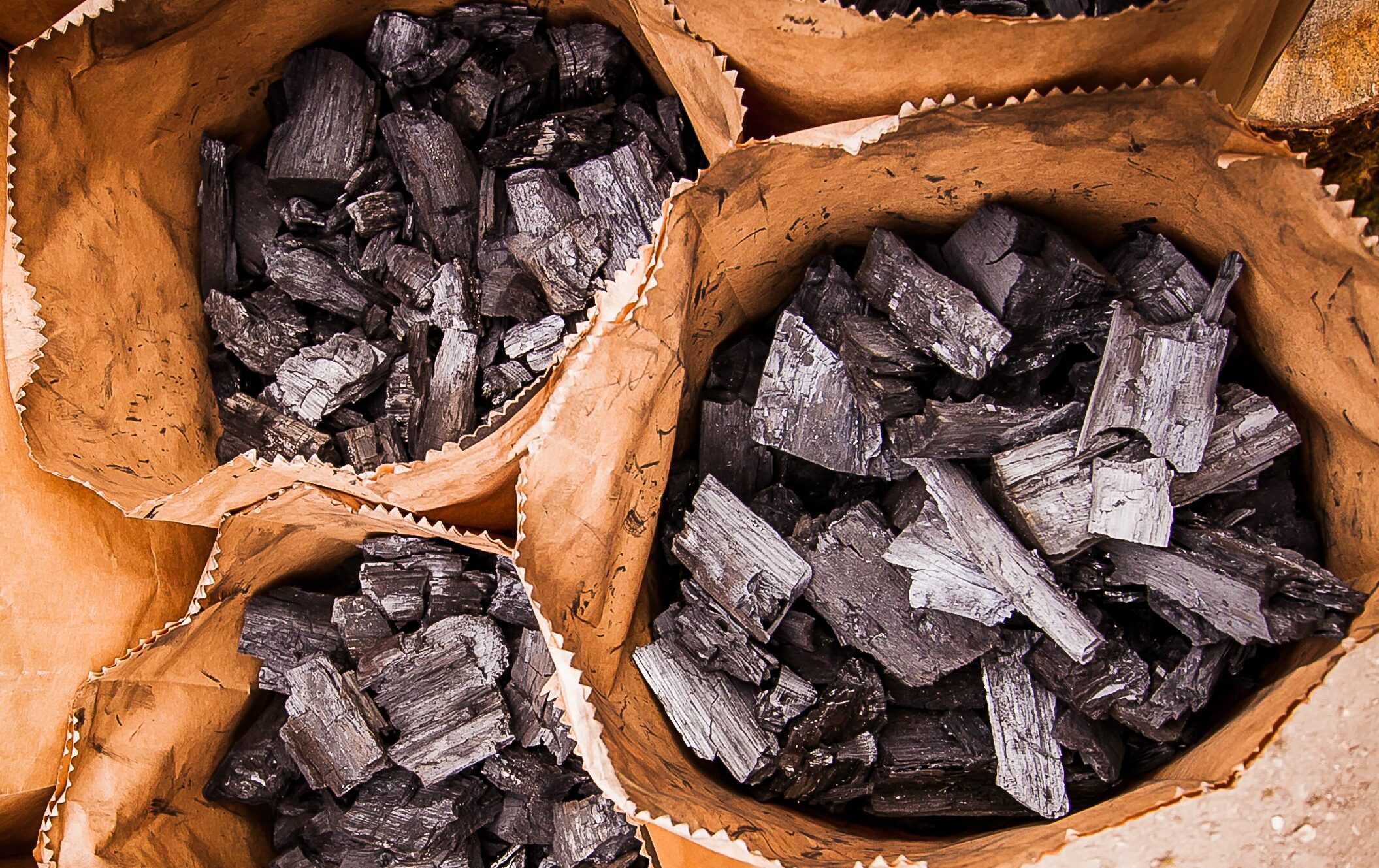
Quality UK produced charcoal is generally sold in Kraft paper bags.
Photo: Jim Bettle
21% of British charcoal imports were from South Africa, 20% from Spain, 18% from Namibia, followed by 14% from Paraguay. Nigeria accounts for 6%, and Indonesia for 4%.
Charcoal is often certified by the Forest Stewardship Council (FSC), the world’s largest certification scheme for wood products. It is meant to show that the wood has been sourced from sustainably-managed forests and that the process has not involved forced labour. However, the FSC has admitted that mistakes have been made in the past and that charcoal from tropical sources has been coming into the British market. It has since tried to improve due diligence standards when suppliers apply for FSC regulation, a spokesperson said, noting that the body also suspended Ukrainian FSC certificate holders in 2019 who had falsely claimed their charcoal was sustainable.
The UK government does not consider charcoal a forestry risk commodity
In 2012, Britain implemented a regulation to ensure imported UK wood products were made from legally-logged timber. Charcoal was however exempted from the law, meaning there is no legal requirement for UK businesses and retailers to source it sustainably or even for it to be FSC-certified.
Absurdly, unlike timber, the government does not consider charcoal “a forestry risk commodity” — a globally traded good and raw material that originates from at risk forest ecosystems such as tropical forest, mangroves and sub-Saharan woodland, whose extraction or production contributes significantly to global tropical deforestation and degradation of the land.
The Department for Agriculture, Environment and Rural Affairs (Defra) has confirmed plans to review the 2012 UK Timber regulations after hosting COP26, the UN climate conference in Glasgow last November. The review has not happened yet, but the ministry has indicated that it is considering adding other products, such as charcoal, to the regulation.
A Defra spokesperson said: “The Government is working hard to tackle illegal deforestation and protect wildlife both at home and
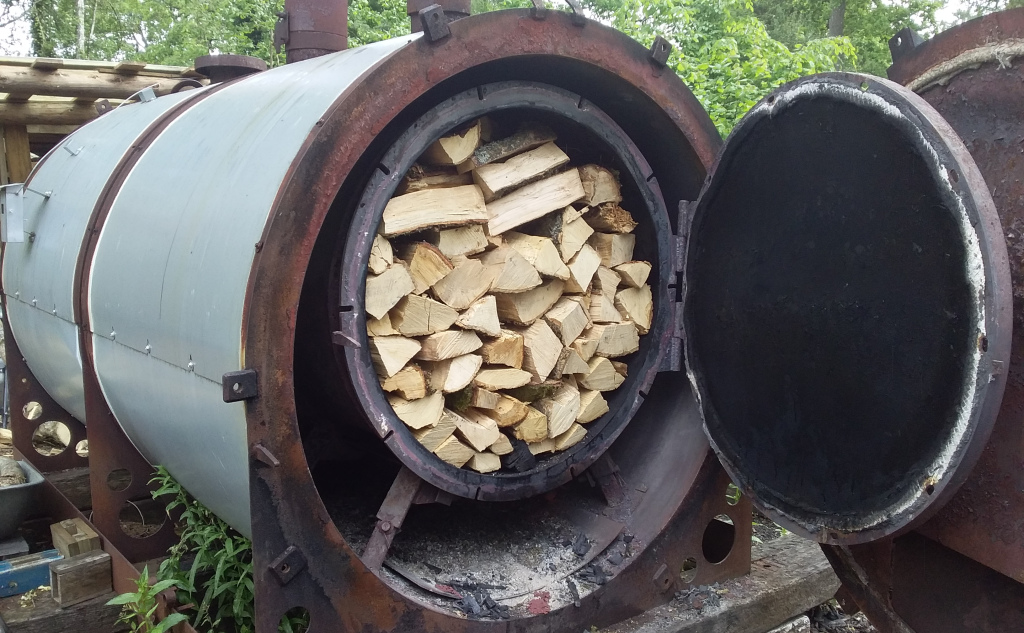
A charcoal retort, ready for firing, loaded with sustainably cut UK wood.
Photo: Suz Williams
abroad. With the Environment Act now law, the UK is committed to going further than ever before to clamp down on illegal deforestation and protect forests, through a package of measures that will ensure greater resilience, traceability and sustainability are built into the UK’s supply chains.”
But Björn Roberts, Earthworm Foundation’s senior forestry adviser, said charcoal’s omission from the regulation “sends the wrong message”.
“Year after year we see new reports of illegal harvest and deforestation in charcoal supply chains feeding UK and EU markets,” he said. It’s now time for charcoal to be regulated in the same way as other forest products, and also to support charcoal producers in ‘problem areas’ who want to do the right thing.”
Jim Bettle, the UK Charcoal Representative at the National Coppice Federation, said that in the meantime, consumers can ensure their charcoal comes from sustainable sources by buying local.

Image: Jim Bettle
“With the focus so much on forest risk commodities, I find it absurd that charcoal is not considered to be one. I was heartened to get to speak to a minister last year who agreed that this was a problem, but as with all these things, there is no timetable for change,” Bettle said. “With no regulation on imported charcoal, it puts UK producers at a huge disadvantage due to the costs that we incur.”
He had this advice for those about to get stocked up for the summer months ahead – “Consumers, look out for British charcoal, it will say on the bag where it’s from. If it doesn’t say then you can pretty much guarantee it’s not sustainable.”
NCFed launches new coppice mapping project
More Coppice Into Productive Management – A new Project for Southwest England which aims to put coppice on the map!
NCFed is delighted to announce that it has been awarded a grant of £160,000 by the Forestry Commission under its ‘Woods Into Management Forest Innovation Fund’ (WIMFIF) to undertake the Project ‘More Coppice Into Productive Management’.
The Project is a great opportunity to improve the understanding of where coppice woodland is located and its condition, as well as to prioritise and promote the active management of coppice woodlands for a wide range of natural capital benefits within Southwest England. Although currently focused on one region, we hope the project will be a template for undertaking similar projects in other parts of England and across the UK.
The Project will occur over three financial years ending March 2025 and focuses on privately-owned coppice woodland (woodland not owned/managed by Forestry England).
The success of the Project will rely on valuable knowledge in put from a range of organisations and individuals who own and/or manage coppice woodland, and we will be asking for their assistance in the coming weeks and months.
NCFed’s new Project is being project managed by Graham Morgan of The SLIM Woodlands CIC.
Any questions, comments or helpful information regarding the Project (for instance where you think coppice woodland is located) should be submitted to Graham on morecoppiceSW@ncfed.org.uk
Periodic updates on Project progress will be added to the NCFed website as well as shared via Facebook and the Cleft Stick so do check back soon!
Membership Review 2022
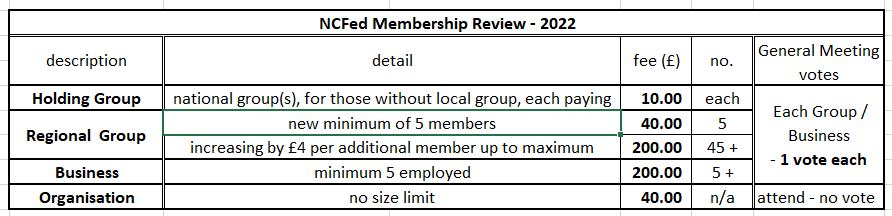
NCFed’s Affiliated Regional Group members agreed in their 19th July 2022 General Meeting to a new structure for membership subscriptions.
Background
The members of the NCFed are the regional coppice groups and supporter groups. Each of these groups has its own individual members. The NCFed itself has no individual members.
Since 2013 the NCFed has requested a membership fee from coppice groups of £2 per person in order for that group to be an affiliated member. It has been widely recognised for some time that this fee needs to rise in order to keep the organisation running within it’s current remit. In addition, the NCFed also has ambitions to extend its activities, including but not limited to mapping coppice resources and promoting coppice education. The organisation has recently been seeking public funds for such developments, but it was felt that it would also be appropriate to ask its members to support that work with higher subs.
The changes outlined below have been the subject of many months of discussion, including 3 Director’s meetings and a survey of NCFed members and those participating in the NCFed Facebook Discussion Page. The survey attracted responses from an estimated 40% of those counted among NCFed’s Member groups. The final proposals for discussion at the recent General Meeting were significantly modified by the views expressed by respondents to the survey. A full version of the survey results is available at the bottom of this page.
The Changes
Minimum numbers and fees for groups
The meeting decided:
- To reduce the minimum number of members to form an Affiliated Regional Group to 5
- For the minimum annual membership fee to increase to £40 per year, rising by £4 per person to a maximum fee of £200.
Previously 10 Members were required to form an Affiliated Regional Group, paying a membership fee to NCFed of £2 per head per year, i.e. a minimum of £20.
Creation of a Holding Group
NCFed was set up to support regional coppice groups and this remains its main focus, with the changes made during this review also designed to favour those groups. However, where there is no group in any region, members have agreed to establish a national Holding Group. This will gather those individuals who are interested in joining a group and help them develop groups in their areas. As members of the Holding Group they will receive support from eachother and NCFed, appointing one member as a group representative to attend and vote in General Meetings. Membership of this group will be set at £10 per person.
Creation of Business Membership
It has long been a challenge for NCFed to represent those businesses that are unlikely to join regional groups. To facilitate Business Membership its General Meeting has agreed to accept businesses with a minimum of 5 employees for a subscription fee of £200 per year. A member business will be able to attend and vote at General Meetings.
Supporter Membership
Since 2015 NCFed has permitted other organisations to be affiliated as Supporter Members. Recently this has included Hedge & Woodland Conservation and the National Society of Master Thatchers. NCFed will continue to encourage other organisations that support its aims to become members for a subscription of £40 per year.
Changes to the membership year
The start of NCFed’s membership year has been re-set to run between 1 August and 31 July. This is to bring it into line with its financial year.
Details of New Membership Arrangements
Membership Review Survey Results
Click here to view / download the full results and analysis
Membership Application / Renewal Form
NCFed Weekend Gathering and AGM 2022 – Save the date!
Friday 14th to Sunday 16th October
Bonsley Wood, Durweston, Nr Blandford Forum, Dorset
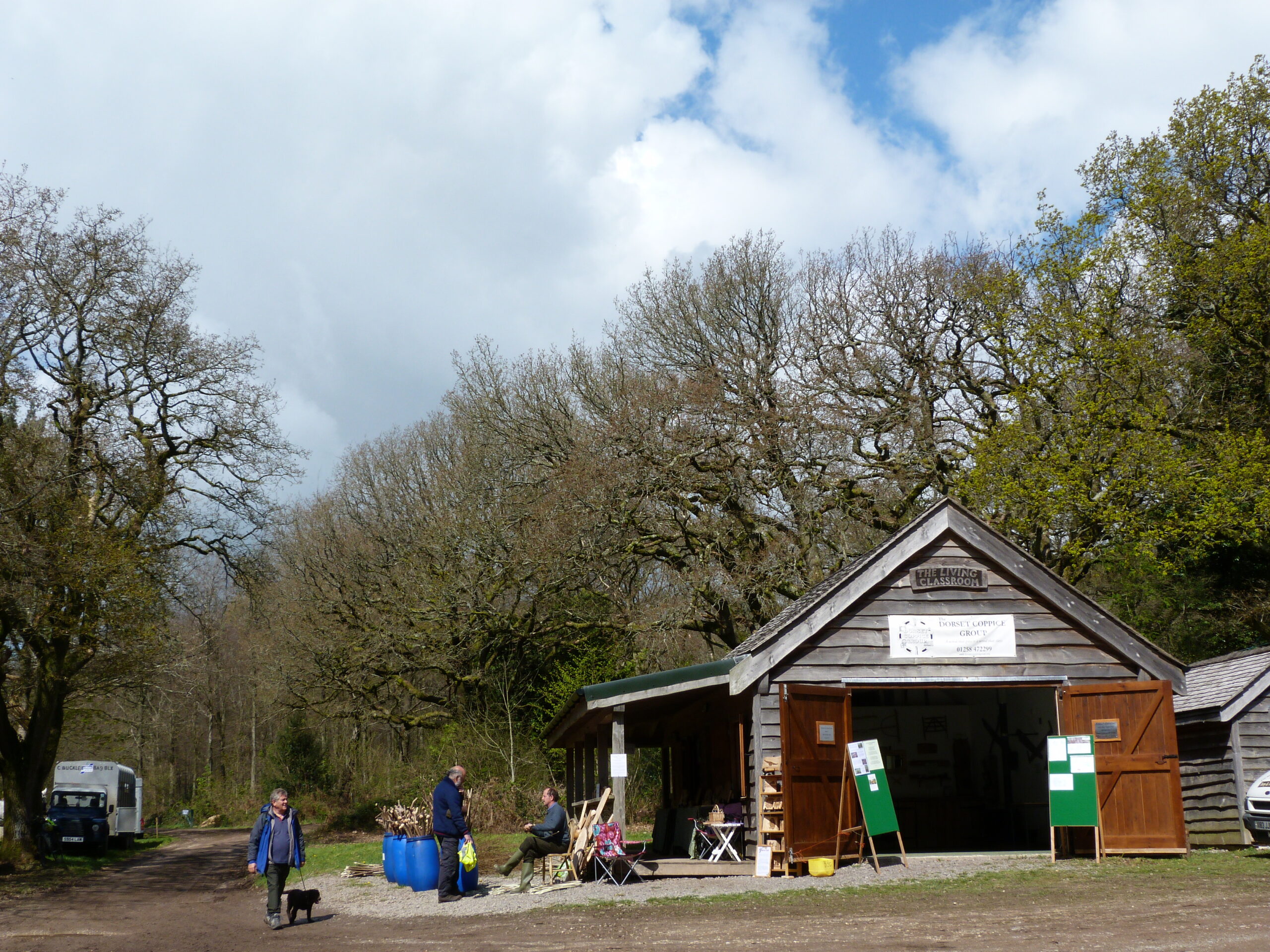 This year’s event will be hosted by Dorset Coppice Group at their beautiful base in the heart of Bonsley Wood near Blandford Forum, Dorset. It provides the ideal setting for the Gathering nestling in an area of approximately 30 acres of mixed, broadleaved woodland.
Bonsley Wood is part of Blandford Forest, a commercially managed Forestry England operation. Dorset Coppice Group have use of the woodland for educational purposes and to manage part of it as a traditional, rotational coppice woodland.
The weekend will be open, via pre-booked tickets, to members of NCFed affiliated supporter and coppice groups as well as non-members. Ticket booking will be
going live on the NCFed website soon.
Keep your eyes peeled for updates on buying tickets, pre-Gathering courses and the programme online, on Facebook or via email from your group rep.

To find out more about Dorset Coppice Group visit their website dorsetcoppicegroup.co.uk or their Facebook page www.facebook.com/dorsetcoppicegroup
Cleft Stick
The newsletter of the National Coppice Federation, for coppice workers and enthusiasts alike, is produced twice a year and aims to round up all the latest news and views from the world of coppicing and deliver them straight to your inbox!
Cleft Stick – Summer 2026
Read it here!
Previous Editions
Read or download previous editions of The Cleft Stick by clicking on the links below.
| Winter 2025-26 | View as a pdf | |
| Summer 2025 | View as a pdf | |
| Winter 2024-25 | View as a pdf | |
| Summer 2024 | View as a pdf | |
| Winter 2023-24 | View as a pdf | |
| Summer 2023 | View as a pdf | |
| Winter 2022 | View as a pdf | |
| Spring 2022 | View as a pdf | |
| Winter 2021 | View as a pdf | |
| Spring 2021 | View as a pdf | |
| Autumn 2020 | Read online | View as a pdf |
| Spring 2020 | Read online | View as a pdf |
| Autumn 2019 | Read online | View as a pdf |
| Spring 2019 | Read online | View as a pdf |