
By Tim Cumine (NCFed Secretary) & Guy Lambourne (Cleft Stick Editor)
Hot on the heels of last winter’s billions of trees promised by politicians, 2020’s lockdown summer threw up a cluster of woodland surveys. The weightiest of these was arguably the Environmental Land Management Scheme (ELMS), the funding mechanism that is set to succeed the EU’s Common Agricultural Policy in England (see the Autumn 2020 issue of Cleft Stick for NCFed’s initial response to ELMs). Here are snapshots of the others.
National Forest Inventory (NFI)
The NFI is how Forest Research maps the woods of Britain. Every five years aerial photography of the country is checked by surveyors who visit 15,000 individual hectares of woodland to confirm that the image corresponds to woody reality. The survey aims to recognise both simple coppice and coppice with standards in its mapping. NFI devotes a whole chapter of its survey manual to recognising coppice in its various forms and states of cutting, storing and neglect.
NCFed published a summary of this work in an earlier News article here – https://ncfed.org.uk/news/national_forest_inventory/ and contributed to a stakeholder consultation in July. Close inspection of mapping produce by the NFI suggests that significant areas of worked coppice might not be plotted by the NFI. This is perhaps because many coupes form small proportions of the woodland within which they reside, woods that are classified according to another majority characteristic. Conversely, we suspect some woodlands e.g. birch regen colonising former clearfell, might show up as coppice, owing to its youth and even age, without anyone ever having planned to cut it for horse jumps or besoms.
There’s a great opportunity here, for NCFed to contribute to NFI’s work in mapping the rise and fall of springing sticks, particularly now as the whole job of organising surveys for the NFI is currently out to tender. NCFed members with a background in forestry/survey are already well positioned to bid for the work, which will be divided into regional lots.
Forest Research might also welcome NCFed Members’ views on Chapter 17 of their survey manual, which tackles the complexities of mapping multi-stemmed trees, regularly cut to the ground and re-growing, and recently tending towards being over-stood. An entertaining read and worthy of experienced coppice workers’ attention and comment – get it here – https://www.forestresearch.gov.uk/documents/3159/17-Coppice-V3.pdf
British Woodland Survey (BWS)
This research, framed by consultancy Sylva, was a rerun of a survey conducted five years ago, seeking our awareness, action and aspirations on woodlands and environmental change. Funded by the Forestry Commission and co-ordinated by the Sylva Foundation, it attracted the views of 1,055 woodland owners, agents, and forestry professionals, representing 3% of privately-owned woodland in Britain.
The survey highlighted that those who care for woodlands and forests across Britain are increasingly aware of the threats from environmental change, especially drought, wildfires, and pathogens, such as ash dieback and acute oak decline, yet there’s little evidence of action being taken overall to improve woodland resilience.
Hand-in-hand with increasing awareness and observation of environmental threats, the report highlighted concerns that many of those who own or manage woodlands are not actively planning or managing in ways which would make woodlands more resilient in future. For example, a minority of respondents had considered local climate change projections or studied the soils that support their woodlands.
A key indicator that an owner or manager has considered threats from environmental change while planning to make a woodland more resilient is having a management plan compliant with UK Forestry Standard. Only 31% of respondents had a UKFS management plan in place, so clearly there’s plenty of work to be done.
NCFed produced a news item about BWS here – https://ncfed.org.uk/news/british_woodland_survey/ – providing more details and links. The results of the survey were published in early October here – https://www.sylva.org.uk/downloads/BWS2020-report.pdf and includes this snazzy summary …
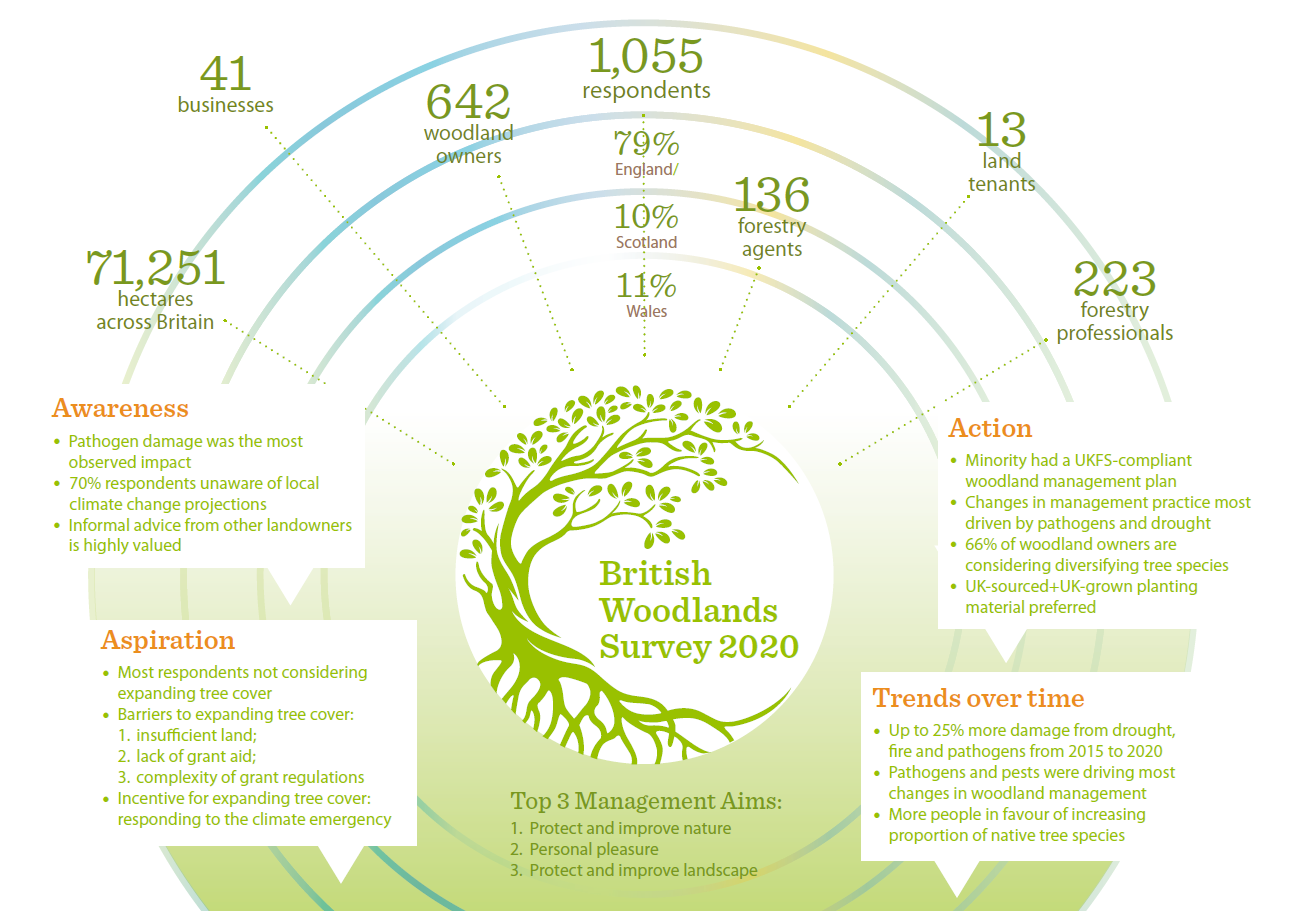
Summary of responses from the British Woodlands Survey 2020
UKWAS (UK Woodland Assurance Standard)
UKWAS is the UK’s expression of what constitutes sustainable woodland management, providing detailed criteria against which forestry practice might be certified. The Forest Stewardship Council (FSC) and the Programme for the Endorsement of Forest Certification (PEFC) are the two principal forest and timber certification standards worldwide. Both recognise UKWAS as meeting all their requirements for confirming responsibly managed woodland.
UKWAS is very similar to, yet distinct from, the UK Forestry Standard (UKFS). If you’re seeking public funds for forestry, UKFS is what your plan needs to conform to. UKWAS is a set of criteria against which well-managed woodland can be certified.
NCFed has a place on the Steering Group of UKWAS, which reserves a certain number of seats for various sectors of woodland activity, such as woodland owners, Forestry Practitioners and the wood processing industries. NCFed holds the only current place of 2 reserved for Forest Workforce. Feel the glow.
See the full breakdown of institutional partners who haul on the helm of woodland wisdom with us here – http://ukwas.org.uk/wp-content/uploads/2020/05/UKWAS-membership-and-Steering-Group-representation-May-2020.pdf
UKWAS has a 5-year cycle of review of its standard. As is the wont and requirement of those immersed in certification, the line and letter of this process is very carefully defined, described here – http://ukwas.org.uk/about/standards-development/. The current process began with a stakeholder consultation between 1 July and 31 August. NCFed is next due to pitch its penn’orth into the pot on November 5th when UKWAS holds its AGM and next Steering Group meeting.
The England Tree Strategy
In case we forgot how many billions of trees were promised during the election campaign of 2019 [1], here’s a handy reckoner:
| Political Party | Millions trees / yr [2] | Equivalent Local Authority District (LAD) |
| Labour | 100 | Tonbridge & Malling |
| Greens | 70 | Lewes |
| Lib Dems | 60 | 1 ½ x St Albans |
| SNP | 60 | 1/5 South or East Ayrshire |
| Conservatives | 30 | Reigate & Banstead |
The job of deciding how we put these trees in place has been allocated to the Minister for the Pacific … and Forests, Sir Zac Goldsmith, formerly editor of The Ecologist magazine. He framed the consultation on where England shall put all its new trees in four sections thus:
| Expanding and Connecting trees and woodland | Protecting and Improving our trees and woodland | Engaging people with trees and woodland | Supporting the economy |
| · Establishing more trees and woodlands and ensuring they are resilient to our future climate, pests and diseases
· Addressing barriers to woodland creation · Creating space for nature |
· Managing woods to recover biodiversity and increase resilience
· Developing our domestic nursery capacity |
· Increasing access to trees in and around towns and cities
· Education and engagement with woodlands · Enabling investment in and protection of green infrastructure
|
· Diversifying rural economies
· Enabling agro and energy forestry · Supporting our timber industry · Increasing forestry skills |
If you missed the 11th September deadline and would still like to answer any of the rib-tickling questions posed by this consultation, you can still have a go at them here – https://consult.defra.gov.uk/forestry/england-tree-strategy/.
[1] General Election 2019: How many trees can you plant?, Chris Morris, BBC, https://www.bbc.co.uk/news/50591261, accessed 1/11/20
[2] The Office for National Statistics (ONS) publishes details of each of 379 Local Authority Districts (LADs). Search https://geoportal.statistics.gov.uk/ for spreadsheets, maps, shapefiles and more. The table above takes the area given by ONS in square metres and was divided by 4 to represent how many trees each LAD would hold if they were planted 2m apart.